
Story-telling and placemaking workshop

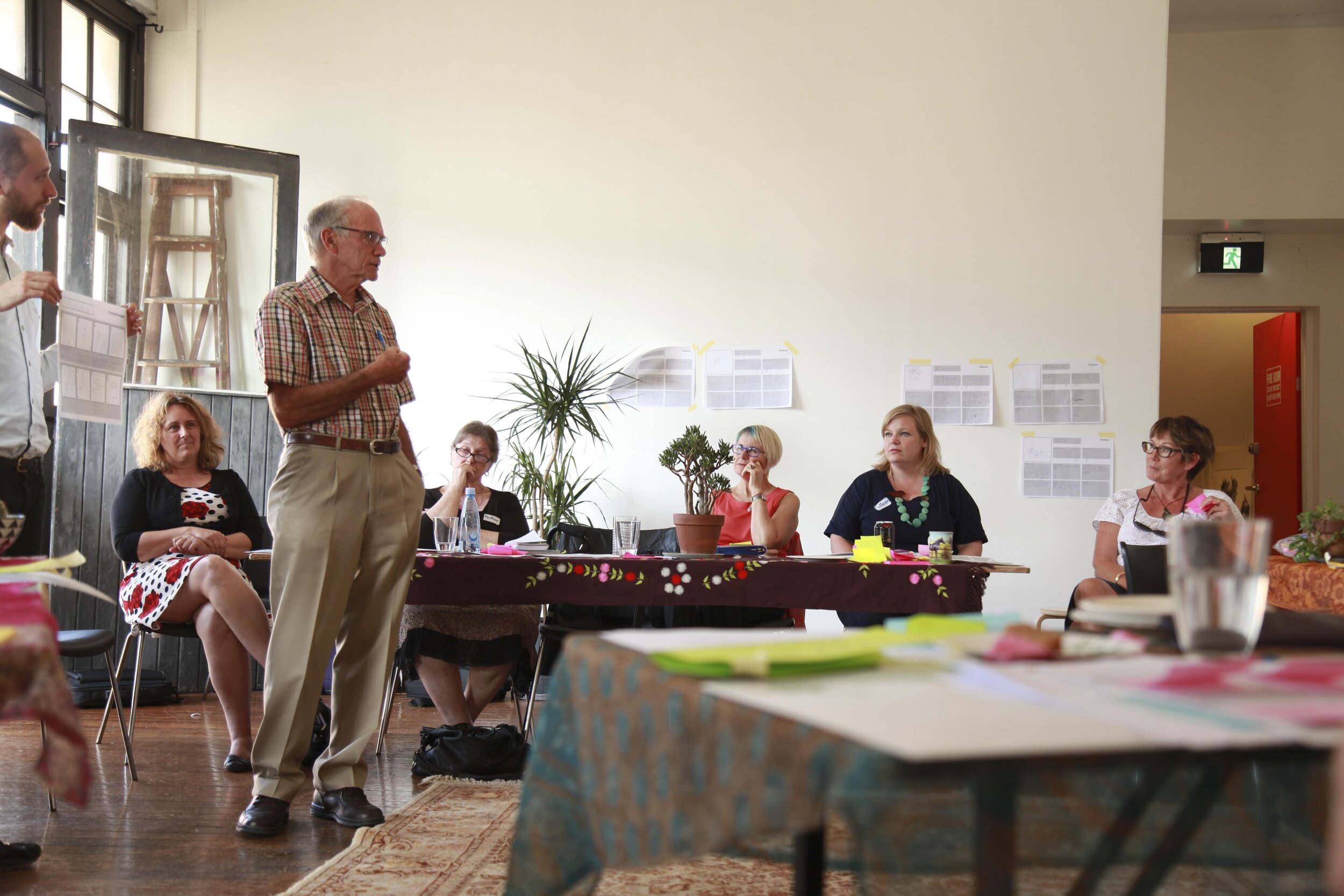
Today I had the opportunity to connect with Artists, Arts Workers and community members from all over Sydney. I was part of a group that were participating  in this:  ”Artist + Community Toolkit Workshop Series‘ – here’s the blurb:

Following the highly successful 2008 and 2009 workshops Penrith City Council continues to grow the edge of creative and collaborative practice with the Artist + Community Toolkit Workshop Series 2010.

Workshops are open to all members of the community, from artists to community workers and anyone who has the passion to create collaborative projects with artists and communities.

Toolkit workshop presenters have included: Information and Cultural Exchange (ICE), BigART, Community Cultural Development New South Wales (CCDNSW), Accessible Arts, Powerhouse Youth Theatre’s Mixed Abilities Ensemble, Arts Law Centre of Australia, The Australia Council and Australian Business Arts Foundation (AbaF) and more..

For further information please contact: Cali Vandyk-Dunlevy, Cultural Development Officer Local, on telephone: (02) 4732 8098 or email cvandyk-dunlevy@penrithcity.nsw.gov.au

Starting in Redfern, we visited the local Community Centre and then Cultural Development Officer Lily Shearer walked us through The Block where the Bi-annual multi-Arts event “Gathering Ground’. HERE is another link about the work they have done. Just fantastic!

We then made our way on the train to Penrith. Shakthi from CuriousWorks, Cali from Penrith Council talked about their story telling work in both the local community and across Australia. In particular we had an opportunity to hear about this:

Neighbourhood Stories is an initiative led by Penrith City Council’s Neighbourhood Renewal Program, which is enabling innovative and creative engagement with local residents across the established areas of Penrith.

The Neighbourhood Renewal Program is a multi disciplinary team spanning community cultural development, community engagement and economic development. The program is focused on developing positive relationships with local communities, working with residents to enhance community strengths.

I met so many fantastic people today and joined in some interesting conversations about the power of story-telling. I even had an opportunity (thanks Cali!) to talk about the project at Penrith High only to discover that someone had seen the performance! What wonderful synchronicity.

It was energising and exciting to think about future projects for GroundSwell that can utilise digital story-telling.

What are the stories you’d tell about grief? Is there an elder in your life who has a story you can capture? Don’t wait! grab your camera and begin!

The ‘people’ you meet on facebook

It seems everyone wants to get on the social media bandwagon, including Death who has set themselves up a fanpage to promote their work. Sounds ominous?

Here’s their intro:

Death. A form of punctuation. Like a period – or what the Brits used to call a “full stop.”  Used at the end of a sentence to indicate it has come to an end. See? Nothing to be afraid of. I mean, you’re not afraid of a “comma” are you?

I have been Death since the beginning of time.  I “began” when Life began. We’re a team.

My favorite movie is “Death Takes A Holiday” – which is a nice thought, because I’ve never had a day off. Ever. I work 24/7. And live…everywhere. I do not discriminate against anyone or anything, so am happy to serve all.

And who knew death was such a friendly and thought provoking character? Being interactive and a bit on the self -deprecating side, they use cartoons and videos to depict just how us mere mortals try to deal with death. It is an interesting read and Death proves him/herself (does death have a gender?) quite the talkative type too! (Though I do wonder if the self deprecation might be masking some self esteem issues? should I say things like that about death???).

Life Before Death is the Singapore based organisation ‘behind’ death on Facebook and through their interactive website they invite us to consider our attitudes toward death. They say “grab the bull by the horns. Live life”. I love it. Supported by the Lien Foundation this innovative website has lots of features which invite us all to do this – live life and make meaning out of our lives in the face of mortality.

We are going to link to some over the next few weeks. join in!

2 people like this post.

Penrith Press – Penrith High School students offer heartfelt gift

The Penrith Press ran with a story about the performance this week, with a fantastic photo gallery. You can read the online version of the article here and the link to the photo gallery is below.

YEAR 11 Penrith High School drama students got into the minds of people living with motor neurone disease last week.

The group wrote, developed and performed Learning to Dance in the Rain about the terminal illness.

The performance was an initiative of The GroundSwell Project, a local non-profit organisation that uses the arts to promote wellbeing.

GALLERY: Penrith High School Groundswell Project Life And Death Drama

“We work with schools and collaborate with organisations such as MND NSW to enable young people to create performances based on real relationships with people who are living with diseases such as motor neurone disease,” The Groundswell Project director Kerrie Noonan said.

“Tuesday’s performance was extraordinary and showed a level of maturity that young people aren’t often given credit for.”

More than 50 family, friends and supporters watched the performance.

Award-winning writer Peta Murray and teacher Nicole Bonfield worked with the students on the project.

“Students have researched, written and developed the 8-10- minute performance together, and they should be proud of the depth and commitment they have shown to the work,” Mrs Bonfield said.

“This kind of experience you can’t get from books. Everyone’s spirit was lifted and for everyone involved it has truly been life changing.”

The students successfully auditioned for the regional drama festival.

2 people like this post.

Gravity, reverence…and questions

Anyone who has ever sat through a piece of issue-based theatre which doesn’t quite work, finds that plays about such subject matter can sometimes be ponderous and self-important. What I call the “Dull, But Worthy” school of theatre-making. Usually it comes when people work too safely, using the theatre forum to tell us what they think we should know about an issue, rather than taking risks to try to share with us what they don’t know.

The performance by Year 11 Drama at Penrith High School was anything but Dull & Worthy!

It had gravity, reality, raw emotion and, reverence… It wrestled with the ambiguity and the paradoxes. It asked: How do we live richly in the face of illness, grief and loss?  A big question. And a sense of danger in daring to ask it.

For me, this is what The GroundSwell Project is about.  Leaving our comfort zones.  Asking the unanswerables. Again and again.

6 people like this post.

Jenny’s speech

Thank to everyone for the encouraging and positive feedback about the performance on Tuesday. I promise we are working on getting some video up soon. In the mean time, many people at the performance commented about the words that Jenny from MND NSW shared with us after the performance. She kindly let us print them here.

What you have seen today has been remarkably powerful and moving, and it is real!

I would like to acknowledge everyone who has been involved in this project for their skill and dedication – it is a credit to all involved-teachers, mentors, students, people living with MND and their carers, and everyone’s family and friends. Not to mention Kerrie and the Groundswell Project whose vision has brought this about.

There has obviously been lots of sharing of stories, laughter and tears and celebration of the positives and negatives of living with such a difficult illness. This has been a wonderful bringing together, via the creative arts, of these drama students and those living with MND to express the challenges faced by those living with such an illness – physical, social and emotional. I’m sure that the meaningful connections and unique collaboration that you have seen today has raised awareness of life and death, grief and loss, and the ability to live with happiness and sadness side by side.

Motor Neurone Disease (MND) is a disease where nerves in the brain and spinal cord die and therefore don’t send messages to muscles, so people lose the ability to walk, use their arms, speak, swallow and eventually breathe. As you’ve seen, everyone with MND is different so some people won’t be able to walk, some can’t move their arms, some sound different because they can’t speak clearly or swallow properly any more.

Motor Neurone Disease is a serious illness – it gets worse as it spreads to different muscles in the body. Some people live longer, but most have MND for 1 – 5 years. There is no cure for MND, and nobody knows why people get it, but there is a lot of research around the world.

Schools have a lot of experience in providing support for students who are facing loss and grief. However, they are less likely to have worked with Motor Neurone Disease as it is a less common life-threatening illness, but also one of the toughest any family has to confront. MND is different from other life-threatening diseases because of its spread of progression and rate of change.

This collaboration has enabled the opening up of all these conversations to encompass all the big questions about life.

We at the MND Association do lots of things to support people throughout their MND journey. We provide equipment, we link people to services, we provide information and education and we run support groups.

This particular collaboration came about after Kerrie visited the local support group to talk about this project and to ask for volunteers. The response was so positive it got going straight away. The project recognises the need for open and honest communication about life’s universal questions. I think that you will all agree that after this enriching and profound shared experience you have all been privileged to be a part of, no-one will ever be quite the same again.

Jenny Judd, Regional Advisor

5 people like this post.

…learning to dance in the rain

It’s a few hours after the performance today at Penrith High School. I feel like a need to catch my breath after the experience today. It’s hard to fully capture with words, except to say that it was a huge success.

I wish that you were all there to see it!

So to begin with here is a snippet of Ashley, Luke and Rachel talking about preparing for going onto the stage to perform.

And some of the feedback from our audience of 50 family and friends.

“moving, intrigued, delighted”

“extremely impressed I thought the crosss generational interaction was very important and effective”

“The Commitment and enthusiasm of the students was very moving”

“This kind of project is extremely worthwhile for high school students to take part in. Many more high schools should be encouraged to learn mroe about life experiences through this program”

3 people like this post.

back to the beginning

I like how Niki describes the process here… Looking forward to seeing the performance on Tuesday.

2 people like this post.

“the arts transform people”

This week at SSE we had the opportunity to meet CEO of Streetwise Opera Matt Peacock. What a great story. What a fantastic organisation making a significant difference for people who are homeless in the UK. Matt talked about the development and learning that came from that first project through to what is now a successful organisation working with over 500 people and 11 homeless shelters and many partner organisations throughout the UK.

When an MP in the 1990s was quoted as saying that the homeless were the people you step over when you come out of the opera house, the residents at the Passage nightshelter in Westminster saw this as an opportunity to turn the tables – if they were in a professional opera production themselves, that would help change the public’s perception of them and turn stigma into celebration.

We ran a pilot project, the Little Prince Project in 2000 which involved workshops at the Passage Nightshelter over 12 weeks to stage the children’s opera, The Little Prince. This was performed at the Royal Opera House Linbury Studio with children from St Peter’s Primary School, Eaton Square, staff from the Theatre Museum and a professional cast. The project saw many of the participants flourish in confidence and proved to us and the staff of the centre that there was an identified need for work of this kind. Streetwise Opera was born.

Here’s the latest video from Streetwise:

My learning from Matt (thanks Matt!!!!) and the Streetwise Opera experience  – 1) pay your artists what they are worth! yes!!! Your participants are worth it! Yes again!!

2) Embed evaluation into the work – report outcomes and the impacts that these lead to. Your organisation is worth it!!

There’s lots more, but these are the two points that resonate with me and GroundSwell right now.

The Arts have the power to transform people. Matt repeated this a number of times and each time he did i thought of one of our participants – B. She and I were walking out the school together and she turned to me and said “you know, I feel really good when I leave here, really good”.

4 people like this post.

sustainability…

This week I left SSE feeling full learning and vicarious experiences. In the hot seat was the wonderful Audette Exel, from ISIS and then after lunch we were passionately drilled about the ‘Program Logic’ with Duncan and Gundula from Social Ventures Australia.

I left with one word on my mind – Sustainability. In fact I leave SSE most weeks thinking about sustainability very often thanks to Julian (from Food Connect) grilling me (and rightly so) about GroundSwell being a charity and completely reliant on external sources of funding. “yes” I agree with him and add “at the moment!”. But sustainability is, without or without prompting from my SSE colleagues, an issue worth pondering.

So meeting Audette was inspirational and thought provoking. 13 years ago she left her corporate job and founded the ISIS group a business that was set up to fund a not for profit – ISIS foundation:

The ISIS Foundation (ISIS) is a unique and extraordinary not-for-profit organisation whose mission is to make a positive difference to the lives of children in the developing world.SIS was established in early 1997 by two inspirational finance lawyers and best friends, Audette Exel and Sharon A. Beesley. They decided they would establish a foundation to benefit children in the developing world, specifically in Nepal and Uganda. At the same time, they established a corporate finance and consultancy business, so that the business could pay the on-going administration and general management costs of The ISIS Foundation. Their idea was to ensure that the foundation was sustainable in the longer term by providing an ‘engine’ for the funding of management costs via the business. The net result of the business funding all these costs is that 100% of donor funds is directed towards project-related costs. At ISIS we believe that the business and non-profit sectors provide exponential benefits to each other when they work hand in hand.

This model makes complete sense to me, and so I ask myself  – what is the best of many actions we can take to sustain GroundSwell? how do we do this from the beginning? and how do we do this and act creativity and consistently with the mission of GroundSwell?

While I am contemplating, a real life example of sustainability in action literally arrives in my inbox! It is an email from Mr Younus Muhd from the Koyilandy Palliative Care Society in Kerala, India. His email has the newspaper clipping below attached!.

I met Younus last year when I attended the Public Health and Palliative Care Conference in Kerala, India and I was fortunate to spend a few days visiting the clinic, homecare team and some of the students from schools and colleges supporting the Palliative Care Society. At Koyilandy the majority of funding comes from ordinary people in the community – most of the donations are 50 Rupees ($1AUS) or less and many school students will give 1 Rupee (2cents AUD) a month with a great sense of pride.

Since last year the volunteer students at Koyilandy have been working on their Social Enterprise activities increasing their fundraising revenue for the homecare services and clinic facilities – you can read in the article they have already sold 50,000 books! I have also blogged about the student led initiative “FootSteps” at the Institute of Palliative Medicine in Calicut, where the profits from the enterprise go directly to the patients who sell their artwork.

I feel encouraged that we too can find a meaningful way forward to sustain our initiatives at GroundSwell. In the short term we are focusing on bootstrapping, building our infrastructure and developing relationships so we can expand our school projects and run our festival in November.

Congratulations to Younus and all the students at Koyilandy!

4 people like this post.

The Festival 2009

In a Blue Mountains park last November we held our inaugural Festival of Remembrance. The rain stayed away and people appeared slowly under the generous arms of an old liquid amber, bringing with them the still-burning flames of their loved ones passed. With Simon playing Flamenco guitar, mementoes were pegged into the tree; letters, drawings, a hat, and a well-thumbed book with what looked like Captain Cook on the cover, feathers, paper cranes, poems penned and people standing at a soft distance in stillness, observing the many hands build a simple monument to those we love that have died.

The festival was something I had done in my own home over the years with friends who had also ‘lost’ someone through death (and seeking to re-locate them?) As an adult there have been several deaths quite close to me. These deaths and the consequent bereavement have had a profound impact on who I am and how I relate to the world. As the intensity of my own feelings lessened I found I could see how beneficial it had been to me to gather around these experiences with other people. Death and grief in our culture is largely contained within the privacy of our own homes and even hearts, yet it is such a common experience we share as humans despite our age, culture, education and wealth. What we don’t do so much in our own culture is connect with each other around these experiences, like for example; the Mexicans in their Day of the Dead: All Souls Day. This event is an annual holiday where people make offerings to their dead through food, humour, creativity and celebration. This is some of the impetus for our festival.

When someone we love dies, everything changes; not only in our outer pedestrian routines that no longer contain that person, but inside we re-orient ourselves to life without this person, and the funeral is just the beginning of this process but often the last formalised context in which to grieve as a community. Grief is, I have discovered over the last 17 years, an ongoing process, we re-orient ourselves again and again around the death, and it’s not necessarily something to ‘get over’, that person remains with us as we progress through our grief and our lives. To continue to acknowledge that shifting relationship in a community grounded in empathy is an experience people may find helpful.

Linda Wilkinson (author of a play about the Glenbrook train disaster Remembering Glenbrook) says of death and trauma “I discovered that healing is about expanding the many facets of ourselves to incorporate trauma, to try and balance it…“

Once people’s mementoes were in place around the tree and we had sat in the quiet with our dead for a while, the children were gathered together and read to from a children’s book.  In the silent wide-eyed awe of ‘story magic’ as my son calls it, the children heard about friendship and death in a language their own. They were left drawing on the earth with bright crayons as the adults were gathered in a circle around them for the ceremony. Stories were shared, poems and eulogies read, even Captain Cook’s presence was elucidated and through the tears, came laughter. People were then invited to create a piece of art together by making coloured marks on a white papier mache bowl passed around, markings that represent ‘where I am at on the journey with the death of my loved-one’. This process led us into song, local choir Pack of Peasants sung us through some heart wrenching Romanian folk songs, mostly about women and their losses, and then Kylie and Jo led the gathering through the singing of a Wailin’ Jenny’s song One Voice. We sang it together as candles were lit, and then sang it again and again. When the music fell away and the ceremony was brought to an end the group felt close and connected, many lingered and spoke and stayed inside the warmth created, perhaps surprised at the tender beauty present in recognising loss in one another.

3 people like this post.